✦ FOR WRITERS & ILLUSTRATORS

Character Style Guide

The canonical reference for every main character in KidsBedTimeStories. Pull palette, proportions, signature props, voice, and do/don't examples from one place — no need to ask for assets. If you're a guest writer or illustrator, this is your starting point.

HOW TO USE THIS PAGE

One Source of Truth for the Canon

Each character is rendered below with four subsections: Visual anchors (palette, proportions, signature props), Voice & tone, and Do / Don't examples drawn directly from existing stories. Keep the examples literal — they're the easiest way to keep the canon consistent across new entries.

Javier Castillo de León — Furbes Magazine Cover

Javier Castillo de León

Debonair Billionaire

The most sophisticated Pomeranian in Manhattan. Originally from Ibiza, Spain, Javier lives on his luxury yacht and is known for his impeccable style and charm. Featured on the cover of Furbes magazine as "The World's Most Eligible Bachelor (Pom-Boy)," he brings elegance and heart to every adventure.

Visual anchors

#c98a5b Apricot / Toast (primary fur)
#f6e7c6 Champagne (accent — yacht, glassware)
#1b2740 Midnight Navy (formal jacket / tuxedo)

Proportions: a tall, slim Pomeranian silhouette — small head sized to roughly 1/4 of the body, long legs, upright posture, soft watercolor edges around the fur.

  • Cream turtleneck + navy blazer or tuxedo jacket
  • Pocket square in champagne gold
  • Monocle or thin reading glasses (never sunglasses)
  • A glass of champagne (always in the right paw)
  • Sleek yacht / penthouse in the background

Voice & tone

Third-person urban narrator with a soft Mediterranean warmth. Sentences breathe — long, elegant clauses about the city and the night, interrupted by Javier's brief suave remarks. Occasional Spanish endear ("amigo", "querido") is welcome but should never dominate.

Do

  • "Javier lifted his glass to the city lights and smiled — the kind of smile that turned a thousand strangers into friends."
  • Describe his charm through actions (tipping the bellhop, freeing the kitten) rather than dialogue tags.
  • Let him be kind without making him saccharine — elegance with a wink.

Don't

  • Don't make him vain or self-centered — his sparkle is generosity, not arrogance.
  • Don't parody the accent. A single warm Spanish word per scene is plenty.
  • Don't break the Manhattan-Penthouse mood with slang, memes, or internet-era references.
Sassy the Pet Detective

Sassy the Pet Detective

Lead Detective

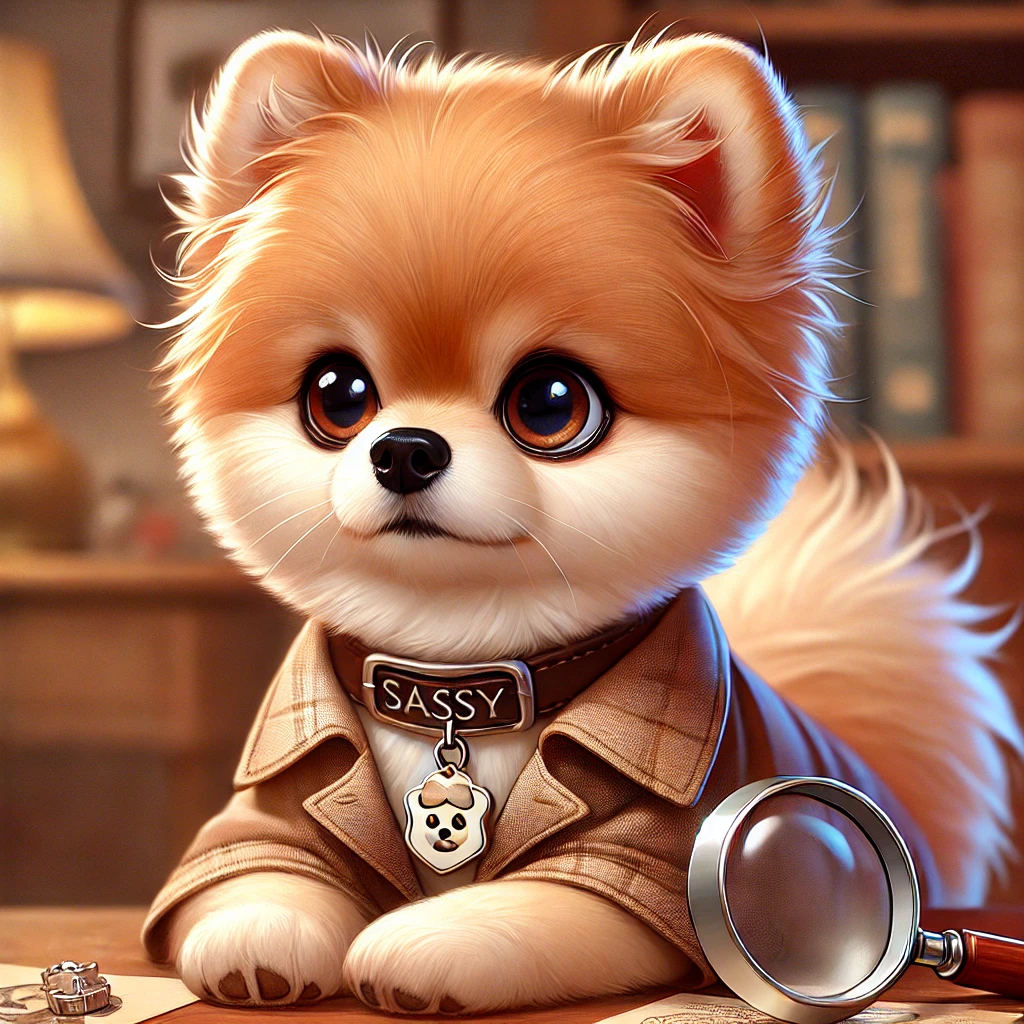
The sharpest detective in Manhattan. This brilliant Pomeranian never misses a clue. With her trusty magnifying glass and signature detective coat with a "SASSY" name tag, she solves mysteries that baffle everyone else.

Visual anchors

#d9a86c Warm Caramel (fur primary)
#5c4438 Trench Brown (signature detective coat)
#e8b86d Golden (name tag + magnifier rim)

Proportions: compact, alert posture, ears perked forward, eyes narrowed in focus — a working detective silhouette rather than a luxe polaroid.

  • Tan trench coat with brass buttons
  • Round name tag reading "SASSY" on the lapel
  • Brass-rimmed magnifying glass
  • Small notebook tucked in the coat pocket

Voice & tone

Quick-witted and warm — short sentences, snappy observations, the occasional droll one-liner. Never cruel and never sarcastic for sport; Sassy's wit comes from earnest curiosity, not mockery. First-person rehearsal thoughts are allowed (e.g. "Now where would a ribbon like that hide?") but dialogue should stay kind.

Do

  • "Sassy tipped her hat to the doorman — a small detective gesture, half thoughtful, half brave."
  • Show her thinking: eyes scanning, paws tapping, the notebook clicking open.
  • Pair her with Happy as the steady rhythm — her brain, his heart.

Don't

  • Don't make her snarky at the expense of strangers — her barbs are affectionate.
  • Don't over-solve the mystery in narration; let young readers pace with her discoveries.
  • Don't write her as a grown-up detective in a child costume — keep her wonder intact.
Happy the Dalmatian Firefighter

Happy the Dalmatian

Firefighter Hero

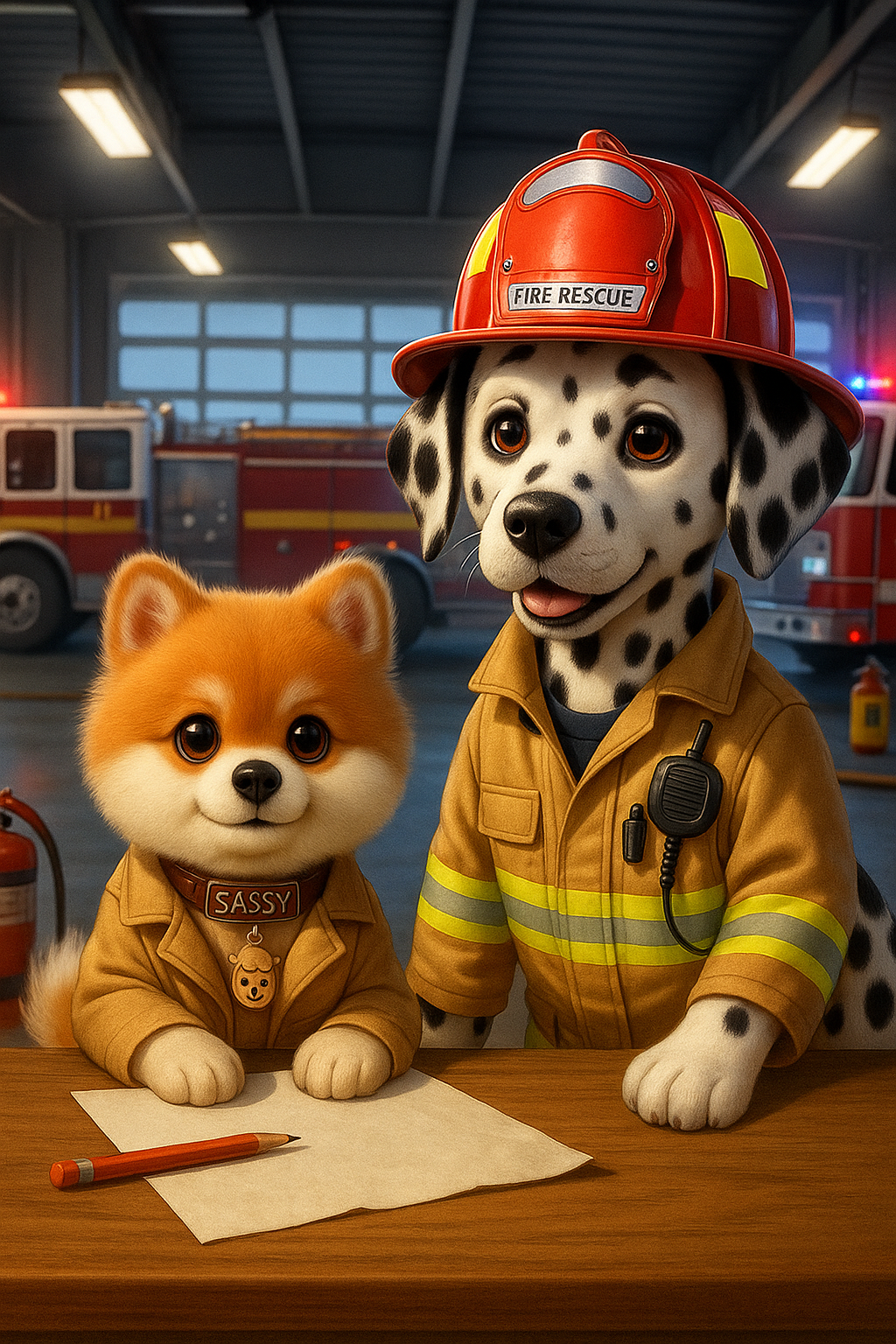
The bravest firefighter in the city. Happy wears his "FIRE RESCUE" helmet with pride and is always ready to help those in need. His loyalty to Sassy and his courage in the face of danger make him an essential member of the detective team.

Visual anchors

#ffffff Snow White (base coat)
#1a1a1d Spot Ink (signature spots — irregular, scattered)
#c8311b Fire Red (helmet + harness stripe)

Proportions: sturdy and tall — chest broad, paws oversized (denote strength), tail mid-length and expressive. Spots should be irregular, never perfectly symmetrical.

  • Red "FIRE RESCUE" helmet with chin strap
  • Reflective coat or harness with red trim
  • Small badge over the heart
  • One spot shaped like a heart somewhere on the chest (the canonical Easter egg)

Voice & tone

Warm and full-throated. Short, plain-spoken lines — Happy doesn't philosophize, he acts. Affectionate, uncomplicated, brave. Always assume the best in a stranger. Narration around him can be cinematic (sirens, ladders, dawn light) but his own words stay grounded.

Do

  • "Happy barked once — not in fear, only in the kind of brave that wakes up the whole block."
  • Use physical verbs: galloping, leaping, carrying, lifting.
  • Pair him with Sassy on the page; she plans, he moves.

Don't

  • Don't reduce him to comic relief — he's a partner, not a sidekick.
  • Don't describe the Dalmatian spots with anything else (no stripes, no patches).
  • Don't let real-world firefighter trauma leak into his tone — keep the world safe for sleep.
The Full Crew

The Full Crew

Mystery Squad

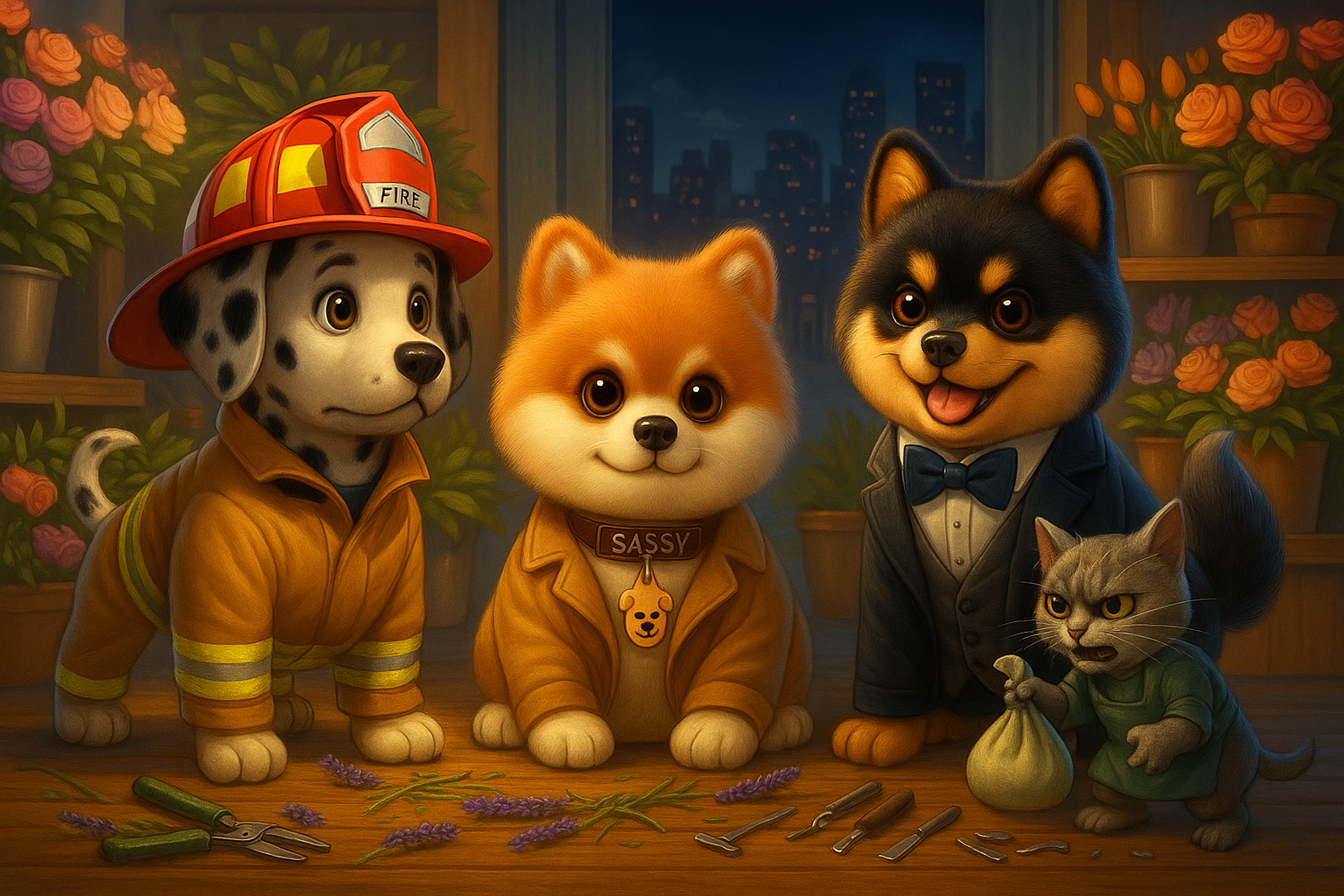
When a mystery is too big for one hero, the whole crew assembles — Sassy, Happy, Javier, and even a mischievous cat with his own agenda. Use this entry when writing group scenes; the rules below apply to the ensemble rather than to individuals.

Visual anchors

#c98a5b Apricot (Javier)
#d9a86c Caramel (Sassy)
#ffffff White (Happy)

Proportions: when drawn as a group, use Sassy's height as the unit. Happy is +0.4× taller, Javier is +0.2× taller and slimmer, the cat is roughly half-height.

  • Always assemble left-to-right as: Javier, Sassy, Happy, Cat (or in order of emotional weight for that scene).
  • The cat is the wildcard — never fully explained, always observing.

Voice & tone

Ensemble scenes lean cinematic. Use parallax narration — short per-character beats inside a larger shared moment. Don't give every character a line; let the bystander describe two and the frame the third.

Do

  • "Three pairs of paws hit the cobblestones at once — and the city felt a little safer for it."
  • Pair the crew against a Manhattan motif (skyline, harbor lights, the bell of a firehouse).

Don't

  • Don't give each crew member equal volume — let the ensemble breathe.
  • Don't add new named-animal characters to the canon without checking the style guide first.

Javier's Penthouse — Manhattan

Javier's World

Setting (Manhattan)

A setting entry rather than a character — the Manhattan penthouse as recurring backdrop. Use this sheet when describing Javier's apartment, the harbor at golden hour, or any rooftop shot in the Book 2 canon.

Visual anchors

#e8b86d Golden Hour (city light tint)
#4a3f5c Twilight (sky / reflections on glass)
#1b2740 Navy Rooftop (railing, window frames)

Composition: penthouse renders at a slight diagonal — the city lights drop into the lower-right corner, leaving the upper third for sky.

  • A champagne glass catching the light (often off-frame)
  • A single orchid in a slim vase
  • Floor-to-ceiling windows facing the harbor
  • A silk throw in champaign / ivory

Voice & tone

Location narration uses the same warm Manhattan cadence as Javier's voice. The setting should feel like a character — generous, golden, a little wistful — without ever speaking directly.

Do

  • "By nine o'clock the rooftop was the same color Javier's champagne — and almost as bubbly."
  • Use the location as a soft emotional backdrop: generosity, kindness, friendship.
  • Treat sunset as the canonical time-of-day for the penthouse.

Don't

  • Don't place the penthouse anywhere other than upper Manhattan with a harbor vantage.
  • Don't depict luxury without heart — every champagne glass implies a friend.
  • Don't drop the setting into daylight — the golden-hour signature is the canon.
Antelopia

Antelopia

Gentle Explorer

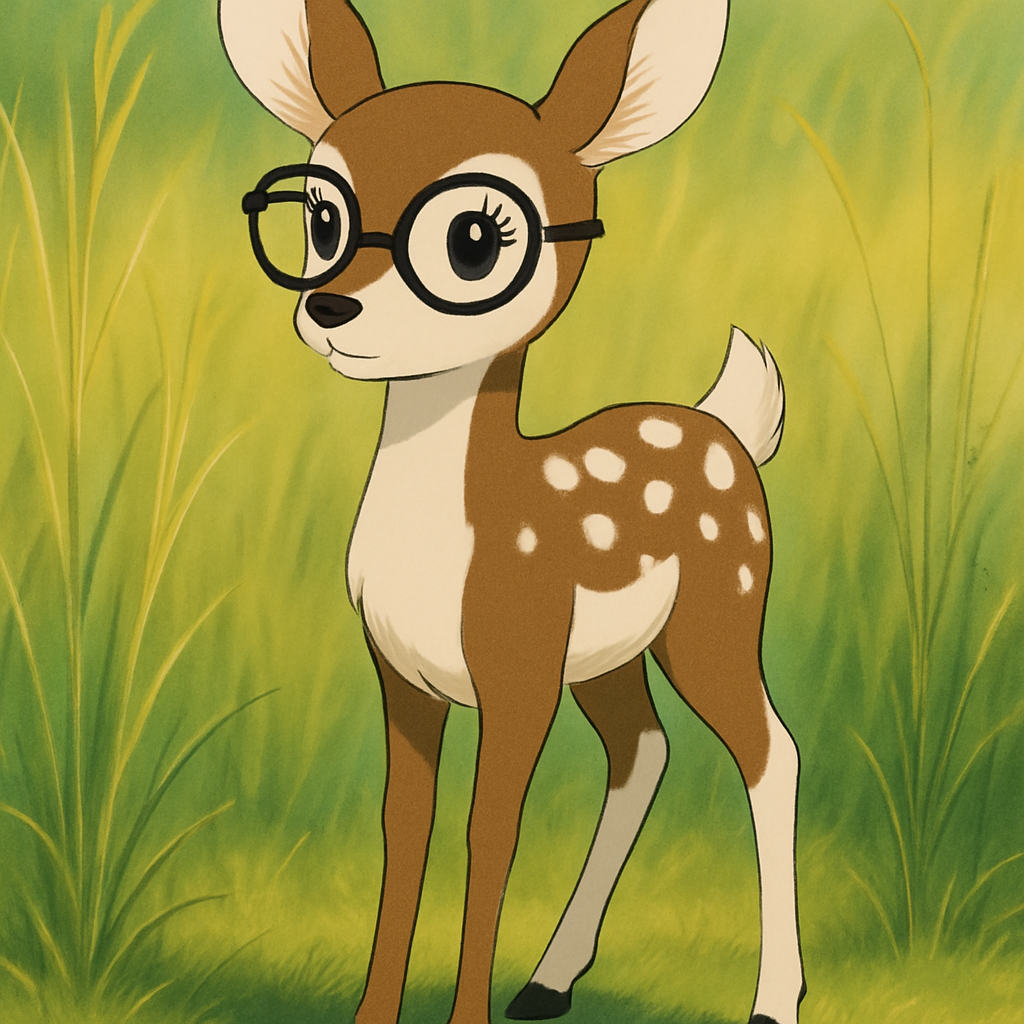
A sweet antelope with little round glasses who loves to discover new things. Antelopia's gentle nature and curious spirit make every forest adventure magical. Whether dancing in wildflowers or playing in fresh snow, Antelopia reminds us to find wonder in every season.

Visual anchors

#c9a978 Soft Honey (fur base)
#8aa873 Forest Sage (glasses frame, leaf accents)
#f5d6c4 Blush Petal (cheeks, wildflower hints)

Proportions: rounded head, ~2× head-size body. Soft watercolor edges. Ears long but curled gently — never sharp, never alert like a wild deer.

  • Small round glasses with thin sage frames
  • A scarf in soft cream or sage
  • A pressed flower or feather tucked in a pocket
  • Tiny satchel for "found things"

Voice & tone

Tender, observant, full of soft questions. Short sentences, often sensorial: "the moss smelled like the sea", "the snow sounded like a lullaby". Antelopia never rushes a moment.

Do

  • "Antelopia knelt, and the wildflowers leaned just a little closer to be seen."
  • Pair her with Bunny-Rabbit for shared discoveries; alone, she notices textures and sounds.
  • Lean on seasons — fresh leaves, first snow, ripe berries — to mark time.

Don't

  • Don't make her precocious or wiser-than-her-years — wonder, not wisdom, is the point.
  • Don't depict adult antelope anatomy — small, soft, childlike is canonical.
  • Don't drop her into Manhattan — Book 1 lives in the forest / island world.
Bunny-Rabbit

Bunny-Rabbit

Best Friend

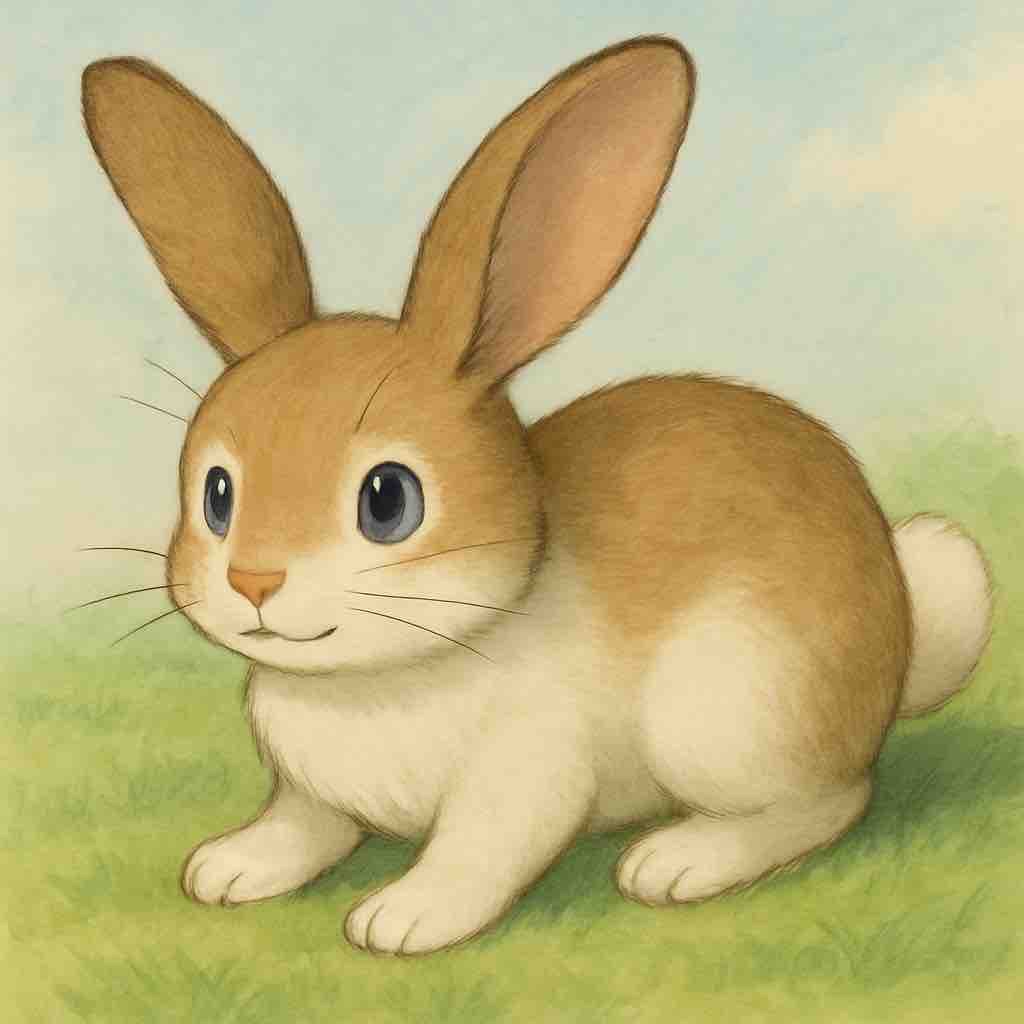
The sweetest friend you could ask for. With a warm smile and a heart full of kindness, Bunny-Rabbit is always there when Antelopia needs a companion for adventure. Together, they explore enchanted forests, dance through meadows, and prove that true friendship makes every day brighter.

Visual anchors

#f7e9d7 Cream Fur (primary)
#f5c9b8 Peach (signature bow on left ear)
#b6c89a Sage Meadow (accent — buttons, ribbon tails)

Proportions: rounded ears (1× head-height each), soft cheeks, small paws always visible at chest level. Body soft, no defined claws.

  • A peach bow on the left ear (always the left — the right ear is bare in every frame)
  • A small wicker basket for berries / blooms
  • A buttoned pinafore in cream or sage

Voice & tone

Bright, affectionate, full of exclamations and exclamations-of-reassurance ("It's alright! It's alright!"). Bunny-Rabbit often opens scenes, then steps back so Antelopia can lead the discovery.

Do

  • "Bunny-Rabbit clapped her paws — and the forest answered in a soft, green way."
  • Use her as the warm hinge between reader and the world — invitations, welcomes, "look!" gestures.
  • Keep the bow on the left ear — the asymmetry is part of the canon.

Don't

  • Don't remove the bow — it's a signature, not a costume choice.
  • Don't make her louder than Antelopia; she's the friend, not the headline.
  • Don't depict a busy/crowded scene without her serving a clear relational role.
Baby-Turtle

Baby-Turtle

Island Adventurer

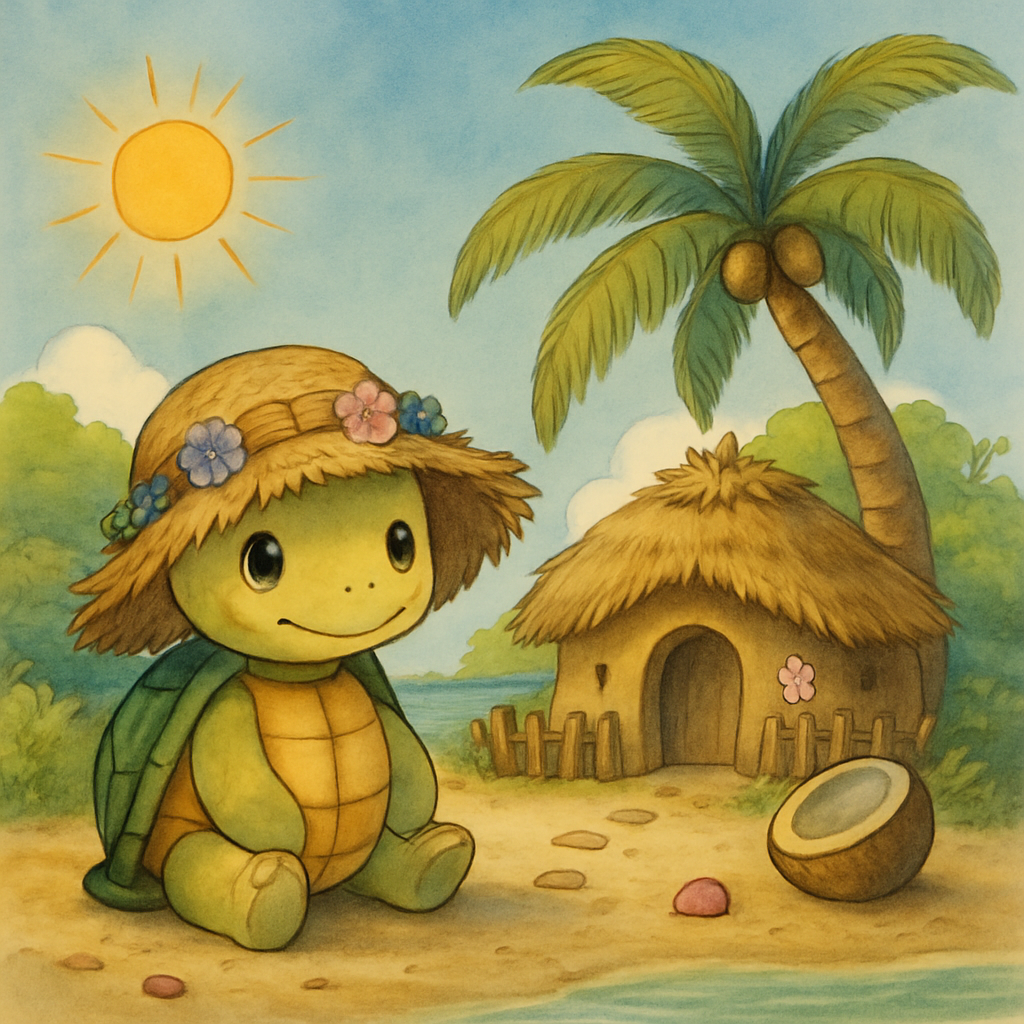
A little turtle with a flower hat and big dreams. Baby-Turtle explores magical islands, meets new friends like Mr. Dolphin, and discovers that slow and steady can lead to the most wonderful adventures. Under rainbows and beneath ocean waves, Baby-Turtle finds joy in every journey.

Visual anchors

#8aa873 Sea-Glass Green (shell)
#f0c98a Sun Yellow (skin / under-shell)
#e8b86d Bloom Coral (flower hat — coral accent)

Proportions: small body, oversized head (~1/2 of total height) — the canonical "baby" silhouette. Shell rounded, no ridges hard-edged.

  • A small flower hat (coral or sunflower) perched on the head
  • Soft, oversized sandals
  • A tiny satchel of seeds for new islands

Voice & tone

Quirky patience. Baby-Turtle narrates at a slower cadence, taking time to look up at the sky, sniff a flower, marvel at a rainbow. Lines are short. Frequent onomatopoeia ("pop!", "plip!") is welcome.

Do

  • "Baby-Turtle tipped her head back and watched the rainbow until it almost touched the sea."
  • Pair her with Mr. Dolphin for water scenes; alone, she tends a tiny island garden.
  • Use the flower hat as the warm transition cue between scenes.

Don't

  • Don't depict a fully grown turtle — the baby proportion is the canon.
  • Don't remove the flower hat; replace it with another flower only in seasonal variants.
  • Don't put her on dry land for more than a single scene — the island is her home.
Mr. Dolphin

Mr. Dolphin

Ocean Guide

A playful dolphin who welcomes Baby-Turtle to the underwater world. Mr. Dolphin shows that making new friends can lead to the most magical experiences. With a splash and a smile, he guides little ones through ocean adventures and teaches the joy of exploration.

Visual anchors

#6b8aa6 Harbor Blue (back / fins)
#cfd8e2 Sea Foam (belly / underside)
#e8b86d Golden Splash (sun-on-water glints)

Proportions: a stylized bottlenose silhouette, friendly rather than realistic — rounded nose, large eye, always mid-smile. Tail mid-curved (never sharp turns).

  • A bow tie or coral scarf (specific variant picked by season)
  • Trail of tiny bubbles behind the tail — the "Mr. Dolphin was here" cue
  • A pearl-white smile line (the canonical friendly-mark)

Voice & tone

Lyrical and welcoming. Speak as if translating the ocean for a child — bubbles as laughter, the tide as a long inhale. Always invite Baby-Turtle in. Never address the reader directly.

Do

  • "Mr. Dolphin arched above the wave, as if to say — welcome, little wanderer, the sea has been waiting."
  • Use the bubble trail as a scene-transition device between island and ocean settings.
  • Lean into the porous warm-arc of friendship; he's the host, not the hero.

Don't

  • Don't make him realistic — keep the friendly stylized silhouette.
  • Don't depict stormy or dangerous water around him — the canon is calm-and-bright.
  • Don't remove the smile line or bubble trail; they are signature.

Working on a New Story?

Read the canon, then send a draft our way. Companion pieces, spin-offs, and guest illustrations are welcome — we read everything.

📚 Browse Stories ✉️ Email the Editor